Thursday, September 28, 2017

Archive Adagio: the memos of yesteryear


Regimes rise and fall, but departmental admins are forever.

Special shout-out in this blog to my Columbia peeps.  Keep reading past the jump for a few Columbia-specific jokes.

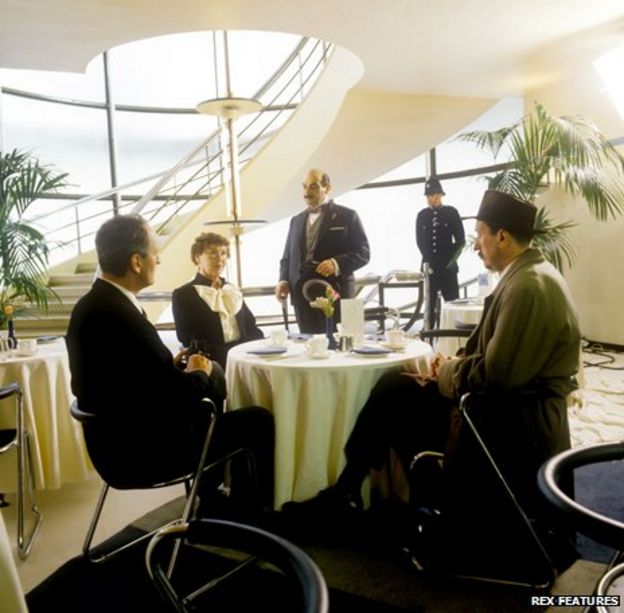
I don't want my reaction to the stupid planes to overshadow what was really the coolest part of my day today, namely my visit to the Residencia de Señoritas, where I was very kindly received, in spite of the archive and library being officially closed for restoration.  (Sadly, the gardens of the Residencia are also closed, which my host today informed me was a shame because especially in the spring they are "una preciosidad" and I can well believe it.)  The Residencia de Señoritas is right down the street from the Museo Sorolla, and shares some of that buildings consciously gracious charm, though in a more modernist (if equally aristocratic) way.  The staircases reminded me tremendously of the sets for the Hercule Poirot series.

De la Warr
Staircase in the BBC Poirot series
Staircase in the Residencia de Señoritas (currently the Fundación Ortega y Gasset-Gregorio Marañón)

You see what I mean?  Allowing for different light and angle, it's that same smooth, creamy white spiral that's trying to be super-modern and also nodding gracefully toward the classic.

"Song of Spain"

"Come now, all you who are singers,

and sing me the song of Spain...

...a bombing plane's

the song of Spain."

-- Langston Hughes, 1937


What.The.Actual. F..."estamos en horario infantil" as they say on Al Rojo Vivo, so I won't complete that phrase, but seriously, the Spanish government needs to chill out, and stop buzzing the embassies of friendly countries (not to mention many pleasant and innocent archives and the researchers therein) in a dubious show of military force.

I know intellectually that Spaniards do desfiles militares rather the way Americans have flags and play the anthem everywhere.  It's basically meaningless, and no one takes it that seriously, or considers it anything other than one of those regrettable relics of the 1950s, that people salute out of habit without particular critical thought or conviction.  But at the point when you send not one or two but a whole flotilla of military planes (a fleet of planes?  a flock of planes?  What's the collective noun here?  Squadron?) plus helicopters, zooming up the length of the Castellana, and flying so low that the nice librarians at the Fundación Ortega y Gasset-Gregorio Marañón have to close the windows against the booming noise, I would say there's a problem.  

When school gets out

This should be an entry with photos, but isn't

I spent the morning doing work emails and setting up appointments with archives, and went out briefly at around 1:00 today to go to the bank (where I got to use my brand new ATM card), and do some minor food shopping.  I happened to head out just as the multiple elementary schools around me were being dismissed for lunch, which inevitably suggested a modified version of the "Teddy Bears' Picnic" along the lines of "at one o'clock, their mommies and daddies will take them home to eat, because they're hungry little teddy bears."  There was the public school down the block, and the two little Catholic schools nearby, the Colegio de Nuestra Señora de los Dolores and the Colegio de Nuestra Señora de la Merced.  The former has a stylish green D (I presume for Dolores) logo on their polo shirts and sweatpants that looks rather like the Ryanair lyre.  The latter does not have as distinctive uniforms, but I happened to walk past them on the way to the bank, so I know who they are.  (The public school doesn't have any uniforms at all.)

Sunday, September 24, 2017

Bike-walking

Commuter biking is a work in progress in Madrid.

My bike, by the Biblioteca Nacional.  It was harder to get there than you would think.
I believe that "la bici es transporte" as the t-shirts say.  But so far I must admit that the handy unlimited monthly bono de transportes seems more practical than my new-old bike, even though the metro is not right at my doorstep (which was one of the things that inspired the bike purchase - that and the "Madrid Celeste" ad campaign I wrote about earlier - I am way to sensitive to propaganda).

I'm used to comparing cycling in New York with cycling in the Netherlands and Flanders, the great bicycle paradises of the world, which make New York seem very shabby and difficult in comparison.  But now I realize how much easier cycling in New York has become over the last twenty years.  Aside from the fact that Madrid is cursed with both steep hills and a climate where the temperature regularly climbs to 30 C (85 F) for four months a year, the "bike lanes" here are rather more theoretical than in New York.  And when I finally arrived at the International Institute (sweaty and terrified) on Friday by bike, I looked around the Calle Miguel Angel and the surrounding side streets for bicycle racks with vain bemusement, and finally remembered, "oh, right, you can lock your bike to the pole of a parking sign."  Locking bikes to street signs was standard when I started riding to work in NY, ten years ago, but first there was a bike rack in front of my school, and then they started popping up along the avenues, and then the side-streets....and now I wonder where Madrid keeps its aparcamiento para bicis, as my little seven year old friend here puts it.  (He has been properly raised to ride a bici and was accustomed to being taken to pre-school on the back of his mother's, so hopefully in another generation Madrid will be the bike-friendly city it aspires to be.)


Saturday, September 23, 2017

The Archive Two-Step (Part 2)

You send an email here, you send an email there,

you do the hokey-pokey and you email everywhere...


My advisor at the Complutense tipped me off that while the archive of the Residencia de Estudiantes was lost during the Civil War, its companion the Residencia de Señoritas succeeded in maintaining its records (perhaps because the señoritas looked less like combatants than their male counterparts -- a common mistake made by people who haven't worked with adolescent boys and girls respectively).  He also helpfully told me what fundación currently has the archive.  However, as I mentioned in an earlier entry, the Fundación Ortega y Gasset-Gregorio Marañón's archives and library are cerrado por obras until January 2019.

I sent them a begging email yesterday, and received a kind response within an hour, saying that they had no record of Dorothy Peterson in their collection (a fellow Fulbrighter who is more experienced in research mentioned at the Madrid Fulbright picnic this afternoon that she never gives specific search terms to archives but instead only asks generalities, so they have no chance to say they have no material -- a good tip for the future), but that they had a computer available in a small section of the library that was rehabilitada where I could consult the digital catalogue of the archives if I wished, and to please let them know. 

Thursday, September 21, 2017

Flamenco in Carabanchel

As natural as salsa in New York

Compases beneath my window call to mind a flamenco lament for the tropics.

Popular culture is such a monetized and controlled thing now (and perhaps always, just in different ways).  We're used to thinking of things like music as being the result of careful advertising, or as propaganda, clichés designed to appeal to tourists, to some mythical "national" identity, or to some kind of brand loyalty.  (Vodafone has an ad playing non-stop across all TV channels here which smoothly slides from a background track of Peggy Lee's song "You Give Me Fever" to handsome young men at their computers humming along to them singing enthusiastically, "Ya tengo fibra...FIBRA!" and dancing in their enthusiasm at having "fibra" aka FiOS internet access.  It's a shame that the nickname for Fiber-optic in Spanish sounds like an abbreviation of fibromyalgia.)

So it's always a bit of a surprise to discover confirmations of things that you normally dismiss as mere tropes.  (Rather like Bart Simpson staring at his dog and saying "you ate my homework?  I didn't know you guys actually did that!")  I had a bit of that surreal experience yesterday afternoon when I woke somewhat groggily from a siesta, and heard what I gradually realized was someone singing cante jondo underneath my open window.  After a few wails of "Por cuuulpaaa de una mujjjjjeeeer" interspersed not with tacones or guitar solos but rather with what sounded like a slightly noisy high school hallway, involving a bunch of boys giving each other relationship advice (at the top of their lungs, because most boys yell as much as they talk) I bothered to get up and look out the window, where I saw a handful of what looked to be late teenagers, wearing sagging jeans, and respectively shirtless or in sleeveless tank tops, with the odd backwards baseball cap.  (The shirtless one was also wearing a crucifix.)  In between warbling like cats searching for mates and carrying on a discussion, they were attempting (not very successfully) to do some acrobatics involving balancing in a split on the bricks of the portico of the apartment across the street.  They weren't able to do it, either because they lacked the strength and skill, or because their high-top sneakers were too slippery, so after a while they drifted away, still chatting and occasionally singing.

Wednesday, September 20, 2017

Strike up the band for the archive two-step...

One step forward, two steps back.

So, aside from doing some shopping and cleaning and going for a bike ride today, I actually started doing my research project.  (Pause for shouts of tally-ho, and snufflings of blood-hounds.)

Following a tip from my sponsor at the Complutense, I looked up the Fundación Ortega y Gasset (and discovered that it is now the Fundación Ortega y Gasset-Marañón), which currently occupies the building that was the Residencia de Señoritas, which accompanied the Residencia de Estudiantes, and was deeply involved in higher education for women in Spain in the early twentieth century.

Success!  The Fundación does hold the archives of the Residencia de Señoritas.  Even better, it includes extensive letters to and from alumnae, and the "expedientes" (or files) of its students.  Even more excitingly, these resources have not been extensively catalogued yet.  I know Dorothy Peterson was in Spain when the Residencia de Señoritas was active, and I know she mentions staying at the "Residencia de Estudiantes," which at the time would not have been co-ed.  So this looks like an excellent lead!

I was deeply excited for about fifteen minutes, while I tried to figure out the protocol for using the archive, and whether I would need my CSIC card, or another letter of introduction from the Complutense, or whether I should just show up.  The web page was not forthcoming.

So I did another Google search and -- despair!  The library and archive of the foundation are (according to another part of the fundación's web page) closed for renovations until January of 2019.

Aaargh.

They do have an email address that research inquiries can be directed to.  I am considering asking the nice people I know at the Complutense if they know anyone at the Fundación on whose mercy I can throw myself.  It's such a perfect re-play of what Arthur Schomburg writes about in "In Quest of Juan de Pareja," when he describes searching the Prado for a painting by Juan de Pareja and being told that it was on the third floor which was "cerrado por obras."  Lucky Schomburg managed to throw himself on the mercy of the director and beg that this was a once in a lifetime opportunity that he had crossed the Atlantic for and could he please, please, please see the painting.  Unfortunately, jet travel has destroyed the "once in a lifetime opportunity" plausible excuse for trans-Atlantic travelers in Europe (though nowadays with the massive pilot strikes that are on the news here who knows?) but still, I only have one Fulbright year, and limited funds and time, and it would be so cool to find more traces of Dorothy Peterson, or even better more of her letters (she was a wonderful letter writer).  Or a draft (or drafts) of the article she published about Spain.  But alas...no guarantees.

So that was today's elation and disappointment in research news.  Fingers crossed that other leads work out.  In the meantime, I've been thinking about how to structure the Peterson chapter, and what to look for about her while I'm here (aside from every single scrap of writing I can lay my hands on).

The archive two-step can be exhausting, but it's exhilarating when you bound forward, and this is just barely the beginning of the first set.  I'm going to get all the way around the dance floor yet.